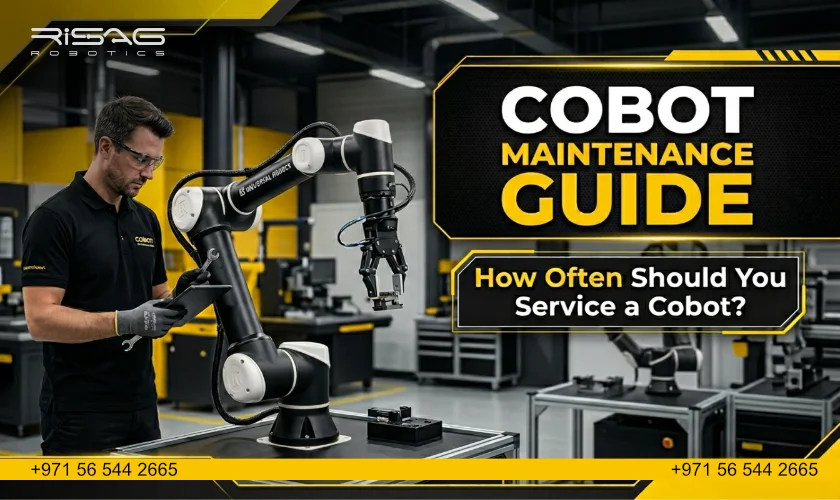
Cobot Maintenance Guide: How Often Should You Service a Cobot?
- event_available 18-05-2026
Cobots or collaborative robots brought a new meaning to automation enabling the safe collaboration of robots and human operators. Unlike the traditional robots, they needn’t be secluded and require less maintenance. With that in mind, let’s not forget the fact that cobots too require proper maintenance to function optimally.
Now let’s get back to the question- how often do you service a cobot? The answer is simpler than you expected. Daily visual checkups, paired with professional maintenance at least once or twice a year. Although there is a tendency to skip servicing, careless practices like these can eventually lead to breakdown and even permanent damage.
This blog guides you through the ideal maintenance practices along with the warning signs to look out for.
Why Cobot Maintenance Matters
The design and make of cobots are more compact and simple compared to the traditional ones. But let’s not forget that they do contain moving joints, sensors, cables, controllers, safety systems and software that should remain in good condition. Therefore regular maintenance becomes non-negotiable.
Factors That Influence Cobot Maintenance Frequency
The maintenance frequency of cobots are influenced by several factors such as :
- Payload weight
- Daily weight loads
- Speed and cycle time
- Workspace conditions
- The shift of the cobots, whether it runs one shift or multiple shifts.
- Total operating hours
Servicing of Cobots: How Often Should It Be Done?
1. Daily Inspection
Operators should conduct visual inspection before starting the tasks. Check for:
- Cable wear
- Dust accumulation at the joints.
- Unusual noise
- Vibration
- Warning lights
Weekly Maintenance
Weekly maintenance of cobots involves:
- Torque verification of joint cover fastener
- The condition of teach pendant cable and connectors
- Leak test of vacuum cup and pneumatic gripper
- Checking the floor markings and guardings
- Function test of emergency stop and safety buttons
Monthly Maintenance
Monthly maintenance usually goes deeper and more detail oriented, involving the inspection of the following:
- Make the sensor read zero when the robot is not moving, otherwise known as zero-caliberation check.
- Check for unusual heating of cobot joints.
- Inspect for micro-cracking in cable covering.
- Make sure that the robot joints aren’t too loose.
- Ensure that the I/O signals working properly
- Clean the fan and air filter inside the cobot.
Annual Maintenance
Once a year, make sure that your cobots get a full comprehensive maintenance check-up, which usually includes the following:
- Replace the grease in the joints of the cobots as per the manufacturer’s instruction.
- Reset the zero-point and the cobot’s position sensors and correct the starting position.
- Conduct a recheck and make sure that the gripper and suction cups are in the right position.
- Test the safety settings of the cobot such as emergency stop buttons and motion sensors.
- Test the brakes for each cobot to ensure that they halt when workers or objects are nearby.
- Compare the current accuracy of the cobot with the original setup data to know whether there’s any change in the performance level.
Common Maintenance Mistakes To Avoid
The intuitive and ergonomic design of cobots doesn’t mean you can slack off in maintenance. No matter how advanced a cobot is, systematic maintenance is what keeps it running. Even a simple mistake in maintenance can lead to costly downtimes. So let’s look at some of the common mistakes so they can be avoided.
- Skipping daily inspections
- Ignoring vibrations and unusual sounds, which are in fact warning signs that something's up!
- Not cleaning the cobot, leading to dust accumulation
- Ignoring the payload capacity and overloading the cobot
- Not checking the cables and other electric connections.
- Delaying maintenance servicing and technical inspections.
- Not tracking of maintenance records.
Conclusion
To summarize the points discussed so far, cobot maintenance isn’t something to gloss over. Regular inspections, monthly checks and annual professional servicing is integral to ensure the safe and accurate performance of cobots.
The servicing requirements of cobots may vary depending on the payload, operating hours and the nature of the task. Therefore, adopting a proactive approach will help businesses to maintain the cobot’s operational efficiency.