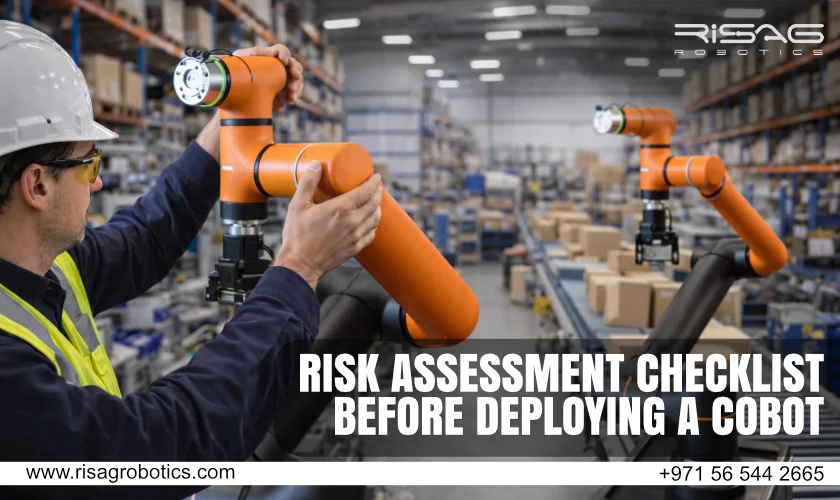
Risk Assessment Checklist Before Deploying a Cobot
- event_available 20-02-2026
Collaborative Robots which are widely known as Cobots are changing the modern manufacturing and industrial environments by working with humans like partners. Before putting a cobot into work it is important to conduct a thorough risk assessment which is critical and it ensures safety, efficiency and compliance of the cobot. This blog will provide a comprehensive checklist to guide businesses through safe and effective cobot roll out.
What Is a Risk Assessment Before Deploying a Cobot?
A risk assessment before deploying a Cobot is a systematic evaluation of potential hazards with installing and operating it in a workplace. Cobots are not like the traditional industrial robots. Cobots are made to share workspace with humans which makes safety analysis even more important.
To provide frameworks for ensuring safe deployment businesses must follow structured evaluation processes like international standards such as ISO 12100 (Risk Assessment and Risk Reduction) and ISO 10218 (Safety Requirements for Industrial Robots), along with ISO/TS 15066 (Cobot safety) to minimize operational and safety risks of the Cobot.
Hazard Identification
This involves identifying all possible risks associated with the cobot’s operation. Hazards may include pinch points, crushing risks, unexpected movements, electrical risks or tool related dangers.
Risk Analysis and Evaluation
If a business finds any hazards in the cobot, the potential severity must be analyzed because this helps the cobot to understand and prioritise which risk requires immediate action and which can be managed by safety measures.
Risk Mitigation Planning
After the team finishes analyzing risks inside the cobot, they should take appropriate measures to control the cobot like installing physical safeguards, software based safety features, employee training and compliance documentation.
Why Risk Assessment Is Essential for Cobot Deployment
If a business deploys Cobots without proper planning, it can lead to workplace accidents, legal penalties, wastage of time and productivity losses. A structured checklist ensures:
- Worker safety
- Legal compliance
- Smooth human-robot collaboration
- Long-term operational stability
- Protection of company assets
Risk assessment is a strategic investment to perform safe automation.
Risk Assessment Checklist Before Deploying a Cobot
Below is a comprehensive checklist with detailed explanations for each key factor for deploying a Cobot safely:
Define the Application and Task Scope
The Cobot should have a specific task of what it does e.g. assembly, packaging, welding, material handling or inspection but each task carries a unique kind of risk. A precise task definition prevents misalignment between robot capabilities and operational requirements.
Workspace Evaluation
Cobots operate on the physical workspace, so it is important to consider floor conditions, lighting, temperature, ventilation and layout and also ensure that there is space clearance required for the robot around it as this will prevent the cobot from accidental collisions. Poor workspace planning can increase the risk of human injury and reduce productivity.
Human-Robot Interaction Analysis
Since Cobots share space with human workers, they will start analyzing how humans interact with the robot. Will the human worker load materials manually? Will humans work side by side continuously? And it will start to identify scenarios where accidental contact could occur and ensure speed and force limits comply with ISO / TS 15066 standards.
Payload and Tooling Assessment
Companies should examine the end effector like gripper, welder, screwdriver, etc. and payload weight because even if the Cobots itself is safe, the attached tool can introduce hazards such as sharp edges, heat exposure or excessive force and this is why business should install proper tooling design that significantly reduces injury risks.
Safety Features Verification
Businesses should verify built-in safety features such as force limiting controls, emergency stop buttons, safety rated monitored stops, speed and separation monitoring and protective stops and also developers must test these systems before full scale deployment to ensure they function correctly under real conditions.
Electrical and Mechanical Safety Inspection
Businesses should inspect the cobot’s wiring, grounding systems, mechanical joints and cable management is important to keep good management of cables because loose cables can cause tripping hazards or electrical faults. Proper mechanical installation gives stable performance and prevents unexpected movement or structural failures.
Compliance with Safety Standards and Regulations
Companies should check that their deployment of the Cobot is aligned with relevant standards such as ISO 12100, ISO 10218 and ISO/TS 15066. In some regions, there may be additional local regulations and also the documentations of the cobot must be maintained to demonstrate compliance during audits or inspections.
Employee Training and Awareness
Operators and nearby workers to the cobot must be trained about the cobot’s functionality, emergency procedures and safe interaction protocols. Lack of training causes most of the industrial accidents and regular refresher sessions can strengthen workplace safety culture.
Emergency Planning and Response Strategy
Businesses should set up a clear emergency response plan in case of malfunction or unexpected behaviour that includes shutdown procedures, reporting mechanisms and responsibilities. Also, clearly marked emergency stops and accessible control panels are essential.
Performance Testing and Simulation
Before the live production of the Cobot, certain steps like conduct simulation tests and pilot runs which monitor the Cobot’s speed, accuracy, repeatability and safety performance. Sometimes cobots can pose real world risks and that's why simulations help detect programming errors or unsafe moments before anything is done in the real world.
Overview of Cobot Uses and Their Risk Considerations
Cobots are getting more and more in number and are used across various industries right now due to the flexibility and ease of integration. Below are some common uses and included risk factors.
Assembly Operations
Cobots help in assembling small components with high precision but there are included risks such as repetitive motion stress for workers and tool related injury and that's why proper ergonomic planning is important for smooth collaboration.
Material Handling
Cobots reduce worker strain because they move heavy or repetitive loads but dropping payloads or improper grip strength can cause hazards so secure gripping mechanisms and payload validation is a must.
Welding Applications
Cobots can perform welding with consistent quality but there are included risks such as exposure to heat, sparks and fumes. Protective barriers and ventilation systems are important in such setups.
Packaging and Palletizing
Cobots can automate packaging tasks efficiently but there are included risks like collisions during repetitive stacking operations. To minimize these hazards, proper speed and control and spatial planning must be settled.
Quality Inspection
Cobots can inspect products for defects by using integrated vision systems but electrical components and camera systems must be shielded properly to avoid malfunction or shock risks.
Machine Tending
Cobots can load and unload machines like CNC equipment but there are risks involved like entanglement or accidental machine cavitation but interlocked safety systems can reduce these dangers.
Pharmaceutical and Laboratory Tasks
Cobots can handle delicate tasks like lab tasks and contamination risks must be controlled through sterile procedures and environmental controls.
Food Processing
Cobots help in the packaging of hygienic food and sorting it but regular sanitation checks and food grade materials are necessary to maintain compliance.
Best Practices for Safe Deployment:
- By conducting periodic safety audits after roll out.
- By documenting all risk assessments including updates.
- By involving cross functional teams (engineering, safety, operations).
- By reviewing the cobot’s software updates before installation.
- By looking at preventive maintenance schedules.
Safety is a process which includes operational changes.
Conclusion
By following structured checklists and through risk assessment, deploying a cobot can significantly improve the productivity, flexibility and operational efficiency and also when it covers workspace analysis, human interaction, safety features and regulatory compliance, businesses can ensure a successful and safe Cobot integration in their company. A proactive approach to risk management to transform cobots from simple automation tools into reliable collaborative partners in the workplace. Still have questions? Why not reach the team at RISAG and get all your questions answered !