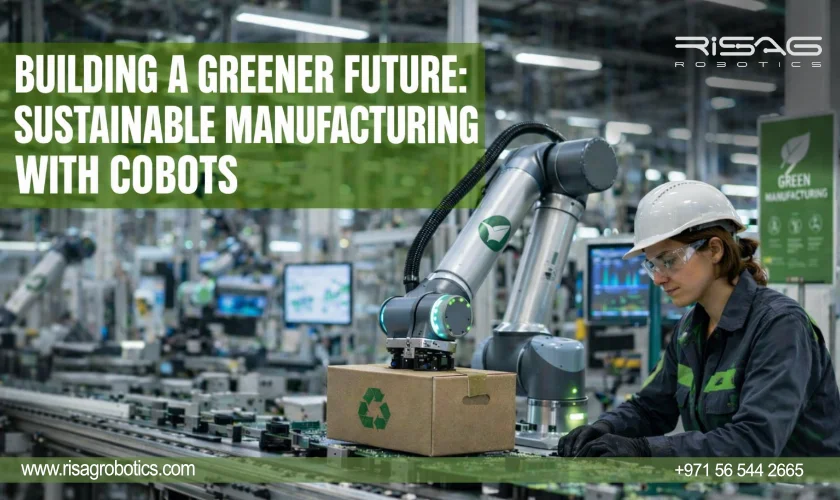
Building a Greener Future: Sustainable Manufacturing with Cobots
- event_available 18-04-2026
Sustainable manufacturing is gaining momentum as an imperative to industries which desire to minimize their influence on the environment and stay competitive. This is being assisted by Collaborative Robots (cobots) which are enhanced to be more efficient and smarter for green manufacturing.
The concept of Sustainable Manufacturing with Cobots
The idea of sustainable manufacturing with Cobot is applied today as the method of describing how collaborative robots can be effectively applied in terms of manufacturing to obtain the optimal distribution of resources, the reduction of waste, and the use of less energy with high productivity. As opposed to the old fashioned industrial robots, Cobots are not as harmful to human beings and therefore, automation can be more flexible, less expensive and reachable by both large and small enterprises.
This is an environmental awareness and cutting-edge technology strategy. By introducing cobots in the manufacturing processes, the companies will not only have chances to be more precise and efficient in how they carry out their work but will also have significantly fewer negative environmental effects. As the needs of industries have been rising to be environmentally friendly, Cobots provide a sustainable solution that not only can achieve the goal of productivity but also sustainable-friendly.
1. Collaborative Robotics Explained
Cobot represent robots of a light and small-sized composition that are not supposed to supplant people, but serve them. They are able to do repetitive, exact or physically straining jobs like assembly, packaging and inspection. With safety and high-tech sensors on them, cobots can detect the presence of people around them and adjust their actions accordingly, thereby functioning in a safe manner.
They are highly elastic, easy to program and can be set up in a very short time. Not only the large manufacturers, but also small ones can easily implement cobots and do not need to make many significant changes in their infrastructure, which is why a greater range of industries might be able to implement automation in a sustainable manner.
2. Sustainability in Manufacturing
The idea of sustainability in manufacturing will focus on reducing the ecological footprint, that is, the reduction of the use of resources, the generation of waste, and pollution (emissions). This includes good use of machinery that is not only energy efficient, it also has efficient processes in production and good utilization of material.
One advantage of cobots to these purposes is that they make it more accurate and more uniform. They reduce errors that raise up wastes and present materials to be utilized effectively and present companies to meet with environmental rules and remain advantageous simultaneously.
3. The Meeting of Technology and Ecology.
The chance of the perfect blend of innovativeness and eco-friendliness is the cobots. They can also enable manufacturers to have real-time information and intelligent automation that can be used to make things more efficient and use fewer resources.
Industries can use human creativity alongside robots to develop smarter production mechanisms that are productive and environmentally friendly. This is the equilibrium to come up with sustainable manufacturing models in the future.
Robots in Sustainable Uses and Benefits of Manufacturing.
Some of the key areas of how Cobots help in making manufacturing more sustainable include;
1. Energy Efficiency Optimization
Cobots save much more energy than industrial robots. They do not use much power and on most occasions they have power saving features when they are idle. This will reduce the consumption of electricity hence manufacturing processes will have less environmental impact and are way more expensive.
2. Minimization of Wastes through Accuracy.
Cobots perform their roles very accurately and hence reduce errors thereby lessening the waste of raw materials. In processes like cutting, welding or assembling, precise motion will be translated to minimum scrap and rework, which is saved in the form of engineering materials.
3. Improved Resource Utilization
Cobots offer equal use of resources and materials owing to the repetitive nature of jobs that have been roboticized. This reduces unnecessary over production and improves better inventory management contributing to efficient and sustainable operations.
4. Enhanced Workplace Safety
The work that is hazardous or labor-intensive can be replaced by Cobots to reduce the risk of any injury at the workplace. A less risky working environment will ensure that there are fewer hiccups, enhanced productivity, and reduced expenses in the event of accidents.
5. Rigid and Scalable Production
Cobots are easy to be reprogrammed and assigned new tasks. This flexibility will allow the manufacturers to become pliable to the demands, will it become wasteful in production doing unnecessary work, and will save on wastage.
6. Reduced Carbon Footprint
Effectiveness leads to minimization of emission of greenhouse gases due to superior consumption of energy. Cobots also assist companies to shift to carbon-neutral production through a process of streamlining the production process.
7. Circular Manufacturing Support
Cobots can help in the process of recycling and reusing material in sorting, disassembling products and reallocating parts to use again. This helps the circular economy where wastage has been minimized and the materials are recycled endlessly.
8. Consistent Quality Control
The quality of products is high when it comes to Cobot since they have the capability to transfer products with high precision. This reduces the defects, the work load is reduced and the resources saved and used on a faulty product are not wasted.
9. Reduced Operational Costs
In addition to a significant investment at the start, Cobots are less expensive in the long term since they save energy and remove waste and improve efficiency. This makes the sustainable practices more economically viable.
10. Innovating the Human-Robot Collaboration.
Monotony of work is eliminated, and the person is no longer forced to waste their time on it. They can begin focusing on innovation and creativity, and problems. This creates new ideas and benefits that even play out further in terms of promoting sustainability.
Conclusion
The next stage of sustainable manufacturing and Cobots could be an efficient and reasonable means of transition to greener manufacturing. Cobots allow minimizing waste, conserving energy, and promoting eco-friendly production by making them efficient, accurate, and flexible. As the industries continue to develop, the future will see a lot of cobots that will contribute to developing a better and sustainable future. To get the best Cobots built with high end technology in the Middle East, RISAG will be your trusted partner.