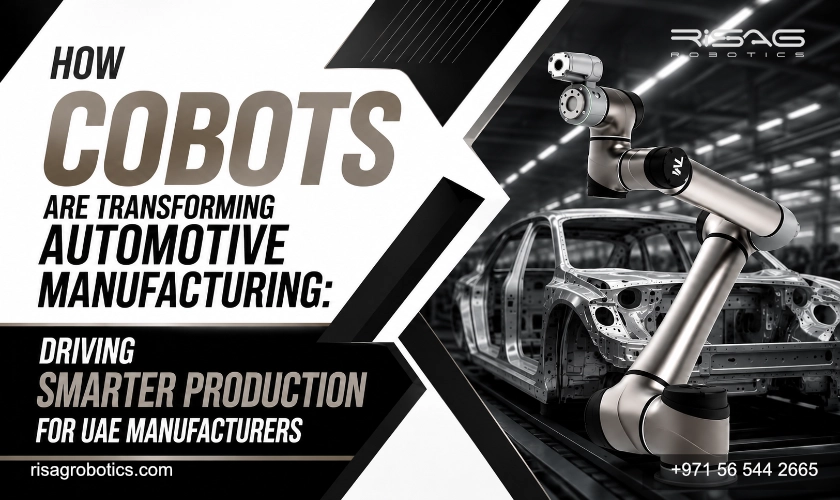
How Cobots Are Transforming Automotive Manufacturing: Driving Smarter Production for UAE Manufacturers
- event_available 29-07-2026
Automotive manufacturing is at the threshold of change. Yes, production demands are high, and so is the need for high-quality vehicle components—which means the pace has to be fast. But let’s be real, the workforce challenges are quite a handful with changing customer expectations and shorter production cycles. So, what can be done to tackle the hurdles?
Switching to smarter manufacturing—automation, yes, but this time more flexible and adaptable to the changing production needs. This is where cobots or collaborative robots become a part of that shift.
Designed to safely work alongside human operators, cobots can easily handle tasks that require a high level of repeatability. And what could be more beneficial for automotive manufacturers in the UAE than a robotic system that eases the job for operators?
But how exactly do cobots make a difference? Let’s find out.
Automotive Manufacturing Is Changing Faster Than Ever
Efficiency demands more from the automotive industry—meeting strict quality standards, faster and flexible production, and timely delivery of components.
Modern factories now are connecting machines, robots, software, sensors, and people, creating a powerful workforce. And the goal is to create a production environment that responds to quick changes, ensures sustainability, and makes better use of resources.
Why Traditional Manufacturing Methods Are Becoming Insufficient
When coming to the automotive industry, it is a known fact that traditional manufacturing methods no longer suffice. Because manual effort alone cannot solve the workspace challenges.
Repeated assembling of numerous components, loading machines, or moving parts consumes a lot of working hours, not to mention the fatigue, risk of errors, and repetitive bottlenecks, which directly affects overall productivity.
The solution isn’t handling the whole manufacturing to cobots; it’s about automating selected tasks so that the operators can focus on work that requires more technical expertise.
High-Impact Automotive Applications of Cobots
1. Precision Assembly Operations
Automotive assembly can’t be done randomly. Let it be installing a sensor or assembling a component; you may have to repeat it multiple times. And the tough part is any minor issue can wreck the process and lead to rework. Cobots become very handy here as they efficiently support repetitive assembly works such as,
- Engine component assembly
- Brake component assembly
- Dashboard assembly
- Sensor installation
- Battery module assembly.
What makes a cobot incredibly useful is that they can be programmed to carry out the job at repeated intervals.
2. Welding Automation
Yet another process where repeatability matters, inconsistent welding costs more than you think—defects, reworks, and additional inspection are the unending loop.
Cobots can be effectively used for applications such as:
- Spot welding
- Arc welding
- Repetitive welding operations
Once you clearly program the cobot, it follows a consistent welding path and repeats the process across different components. This reduces the repetitive welding work that’s manually performed and enables the workers to focus more on quality control, supervision, and other important tasks.
3. CNC Machine Tending
See, the manual loading and unloading of each component means the CNC machine spends most of its time waiting. This is where cobots become advantageous. They help in:
- Loading a component into the CNC machine
- Removing the finished part
- Preparing the next components for processing
The best part is cobots can repeat these tasks without needing any manual intervention. As far as manufacturers are concerned, this translates to getting more productive hours from the same machine and less worker fatigue.
4. Vision-Based Quality Inspection
Manual inspection of components can take a lot of time. Here too, cobots can be integrated with cameras and other vision systems, enabling a more automated inspection. This way cobots can be used for:
- Surface defect detection
- Component alignment checks
- Missing-part detection
- Assembly verification
- Assembly verification
This way manufacturers can inspect the components quickly and identify issues at the earliest.
5. Packaging and Palletizing
Production isn’t the end line of manufacturing—it has to be sorted, packed, moved, and prepared for storage or shipment. Cobots can actively support repetitive activities such as:
- Automotive spare parts packaging
- Component sorting
- Product placement
- Palletizing
- Box handling
How Cobots Can Improve Overall Equipment Effectiveness (OEE)
Overall equipment effectiveness is the scale based on which manufacturers can assess if automation is actually improving operations. OEE looks at three key areas: availability, performance, and quality.
In the context of availability, cobot machine tending helps in the quick loading and unloading of key components, saving production time.
When it comes to performance, cobots easily automate repetitive steps, ensuring a smooth workflow with minimal interruptions.
Combining programmed repetition with automated inspection, cobots ensure not just speed, but also the quality of the components. manufactured.
Cost Benefits of Cobot Automation
Let’s be real, cobots are not a low-cost investment, but the high upfront cost is absolutely worth it considering the long-term benefits they provide. Since they handle repetitive tasks, workers can focus on high-value activities. Moreover, cobots ensure high repeatability and consistent working, thus reducing the cost of rework and replacing defective products.
In short, cobots can help manufacturers achieve potential savings from:
- Low rework
- Less material waste
- Less quality-related failures
- Greater production
That being said, the actual ROI also depends highly on the application. The cobots used in high-volume production can give a different return compared to the one used in low-volume tasks. So while choosing cobots, manufacturers should consider long-term ROI as well.
Why Automotive Manufacturers in the UAE Are Looking Towards Automation
The UAE’s industrial sector is developing to a higher level, focusing more on technology-based manufacturing. The industries are on the move to increase overall production efficiency that can help them to compete in both regional and international markets.
As far as the automotive manufacturers are concerned, this lean towards automation ignites attention and interest towards more vast areas such as:
- Robotics automation UAE
- Industrial automation UAE
- Smart factory, UAE
- Manufacturing automation UAE.
As Industry 4.0 takes the stage, manufacturers need to think beyond just machines and adopt ways to upgrade them. And what’s more suitable than cobot integration?
Key Factors To Consider Before Implementing Cobots
1. Payload Capacity
How heavy are the tools and components? Can the cobot bear its weight? Yes, payload capacity is crucial, and make sure that the cobot you choose can handle the daily weight requirements.
2. Reach Requirements
Can the robot reach the required positions? So consider the workspace layout while choosing the cobot.
3. End-of-Arm Tooling
Choose the right tooling that suits your application. Some of them may include:
- Grippers
- Vacuum systems
- Welding tools
- Custom tooling
4. Safety Requirements
Look into the safety features of the cobots, such as motion detectors, emergency halts, and other vision systems.
5. Integration
Well, cobots don’t work alone—in most cases, they may need to communicate with CNC machines, conveyors, cameras, or other factory equipment. Therefore, consider the prospects of smooth integration.
6. Scalability
Manufacturing requirements are hardly static. So choose cobot systems that can be easily adapted or expanded according to the changing manufacturing demands.
Conclusion
To sum up, the automotive manufacturing sector of the UAE is entering the field of a flexible and connected automation sphere. Cobots largely contribute to this transition, addressing the various production challenges from repetitive assembly and welding to machine tending, material handling, and quality inspection. You can call an automation successful only when it tackles the issue, measures the ROI, and selects a technology that well integrates with the existing production line.
If you are looking to upgrade your automotive sector, then Risag Robotics is the automation partner you can trust. Our product range includes high-performing and reliable cobots that help streamline repetitive tasks, work safely alongside workers, and ensure consistent results.
With the right automation strategy we will help you take practical step towards smart manufacturing.