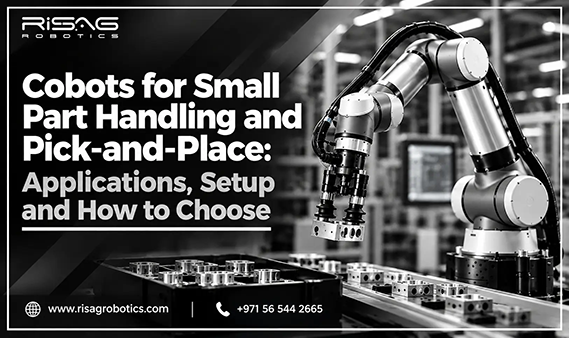
Cobots for Small Part Handling and Pick-and-Place: Applications, Setup and How to Choose
- event_available 30-10-2026
Say your team spends hours sorting products, picking up items, or placing them into trays. As the production demands increase, keeping up with these repetitive tasks can become quite challenging. It is tiring, time-consuming and, let’s admit, pretty boring as well, leaving less time for tasks that need actual human attention. This is where cobots make things easier. These collaborative robots automate much of this work, taking over such repetitive tasks, reducing manual work.
But with different models available, how do you know which one to choose? Let’s find out.
What Is Cobot Pick-and-Place?
Cobot pick and place is a process where the collaborative robot picks up an object from one location and places it in another designated spot. This process involves four steps:
- Locate: Identify the object’s position
- Pick: Pick up and grip it securely
- Move: Move them to the required location
- Place: Release it onto a tray, machine, or the packaging area
Depending on the application, the cobot may use programmed positions, sensors or a vision system to locate the parts and place it accurately.
Where Can Cobots Handle Small Parts?
Cobots can automate several repetitive tasks, such as:
- Machine loading and unloading: insert parts into machines and remove the finished ones.
- Sorting: separate the components based on its type and position.
- Assembly feeding: supply components to the assembly stations.
- Tray-to-tray transfer: move objects between the trays
- Kitting and packaging: collect the component for assembly or place the products into boxes or cartons.
Which Industries Can Benefit from Cobots?
Cobots are used across diverse industries where products or components need to be moved repeatedly
- Electronics: handling connectors, circuit board components, and small housings.
- Food and beverage: moving the packaged products into trays and cartons
- Pharmaceutical packaging: transferring the packed products between the handling and packaging stages.
- FMCG: sorting and packing consumer goods and other personal products
- Light assembly: feeding components to workstations.
How Does Vision Help a Cobot?
Parts don’t always come in the same position every time. The cobot can’t afford to miss one. This is where vision becomes important. The vision system uses a camera to identify the part’s location and orientation. This way the cobot can adjust the movement accordingly. Without a vision, a cobot may depend on the fixed pickup position.
That being said, how reliable the vision systems are depends on the suitable lighting, camera placement, and clear images. Several factors such as dust, glare, and the change in light can affect detection.
What Should You Check Before Choosing a Cobot?
There are certain factors that you need to consider before choosing the right cobot for your facility:
- Payload: consider the object, the gripper and the attached tools.
- Reach: make sure the cobot can reach the pickup and placement points.
- Repeatability: check whether it can reach the positions consistently
- ycle time: look into how quickly it must complete the task.
- Gripper: choose a vacuum or soft gripper to suit the part.
- Integration: check for its compatibility with the conveyors, machines and sensors.
How Many Parts Can a Cobot Handle Per Hour?
For instance, let’s say one pick-and-place cycle takes five seconds:
- 3,600 seconds ÷ 5 = 720 parts per hour
- 720 × 8 hours = 5,760 parts per shift
This example assumes one part per cycle and continuous operation. The actual output depends on the gripping time, vision processing, interruptions, and movement distance, and part complexity.
How Is a Cobot Setup Installed?
A cobot setup consists of the following steps:
- Define the task: this involves mapping out the required output, identifying the parts, pickup and placement points.
- Choose the gripper: make sure the gripper holds the parts securely.
- Plan the layout: position the cobots and their corresponding fixtures
- Configure vision: if there are chances for parts coming in varying positions, install a camera.
- Program and test: run a test and check the movement, gripping, accuracy and the cycle time.
- Assess safety and train operators: Understand the potential risks and train the operators to use the cobots safely.
When Is a Cobot Not the Best Fit?
If your production requires high speed and output, it is better to choose dedicated automation. Because often these tasks may involve difficult-to-grip or highly variable pars, which under such circumstances may require specialised tooling. Remember, the best solution always depends on the production requirements.
Cobot Support from Risag in the UAE
Choosing the cobot isn’t just about selecting a robot arm and calling it a day. There are a lot of factors that need to be considered such as the workspace layout, gripper, fixtures, vision and the integration with the existing equipment.
Are you ready to automate small-parts handling? At Risag Robotics, we help businesses in the UAE to explore and find the best cobot solutions for their production requirements. Our versatile product line from Techman offers versatile and high-performing cobots that take up the repetitive handling requirements. Contact us today to know more.