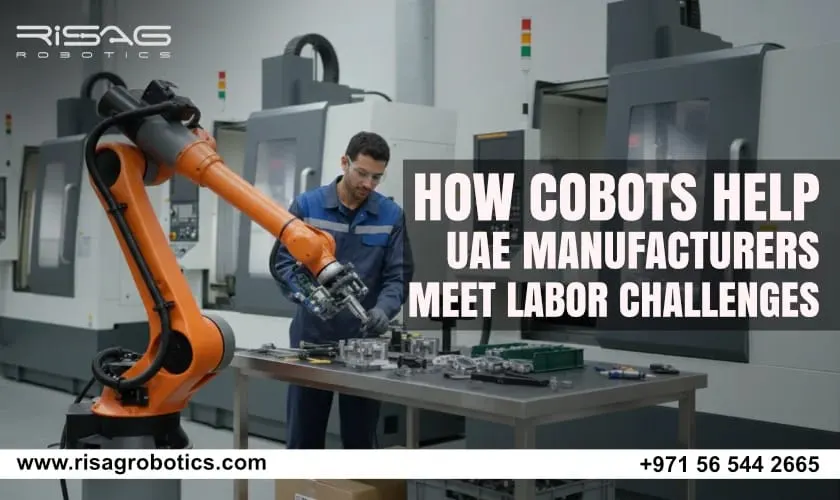
How Cobots Help UAE Manufacturers Overcome Labor Challenges
- event_available 16-01-2026
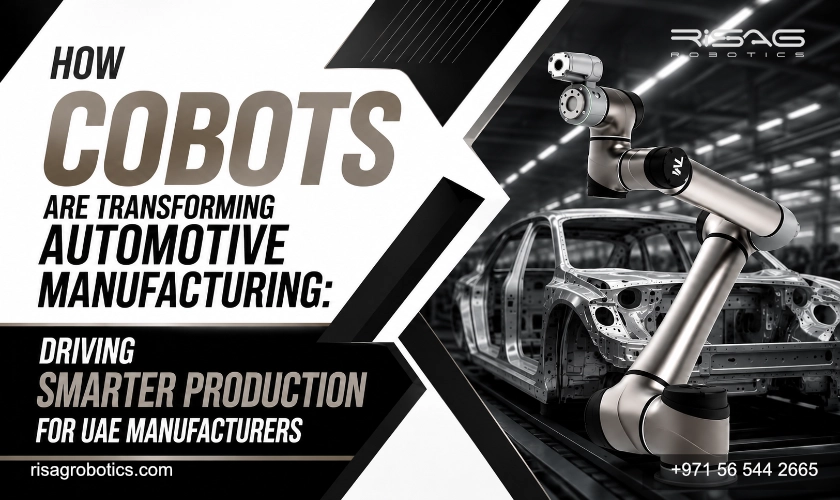
For the past few years, Dubai has been witnessing a surprising transformation in its manufacturing sector. Propelled by the swift growth in economy, advancement in technology and strategy diversification, manufacturing companies all across the United Arab Emirates have been on the search for inventive solutions that will help them stay competitive in the global market. A major influential technological advancement in state-of-the-art manufacturing is the acquisition of collaborative robots, often termed COBOTS. In contrast to conventional industrial robots which work in isolation, Cobots have been designed and developed to operate safely along with human workers. Through this blog, we shall explore how Cobots help the manufacturers in UAE address the challenges faced in labor, enhance productivity as well as create a more sustainable future for the market.
Understanding Labor Challenges in UAE Manufacturing
UAE has a diverse manufacturing sector which spans across industries like chemicals, food processing, automobile spare parts, metal fabrication as well as electronics. Irrespective of the aspiration and investments behind the country’s industrial vision, there are numerous challenges faced by manufacturers in terms of labor.
Not having proper availability of workforce is the first and foremost issue. Having skilled labor in the team is always a tough situation and expanding the team with exceptionally skilled workforce would require talents to be hired from outside of the country. This strategy could be expensive and the vast demand for these skilled workforce and engineers translate to businesses struggling to fill such key positions.
Another challenge faced is the huge cost involved with recruitment of labor, retention as well as training. Recruiting the workforce from outside the country involves a lot of cost related to visa, travel, relocation support and competitive salary. It takes a lot of time and investment to train the new workforce when it comes to complicated manufacturing. Also, workforce turnover can cause loss in productivity as well as inefficiency in operation.
Demands fluctuate with the season and this can also change the requirement of the workforce. When the manufacturing periods are at its peak, there will be a need for more workers in order to meet the deadlines whereas offseason periods will see overstaff as the workload is less. This kind of ebbs and flows will make workforce planning complicated and more costly.
Lastly, the whole world is turning into automation now and is being driven by the Industry 4.0 guidelines where the nation pushes its manufacturers to think of ways to integrate humans with robots to maximize efficiency and quality. With respect to this initiative, cobots are gaining more popularity now.
What Are Cobots?
Cobots represent a new age of automation technology developed to help humans and work alongside them rather than replacing them right away. In contrast to conventional robots that need safety cages and in-depth programming, Cobots are very compact, versatile and effortless to deploy. They are capable of working alongside humans, to share repetitive jobs, tiring or those that possess ergonomic challenges.
Cobots are integrated with sensors that offer advanced functionalities and intelligent programming consoles which will permit them to act according to the presence of humans and force. This implies that it can be stopped safely or slowed down when they sense a human coming into their workspace. The increase in cobots has offered manufacturers to think about the conventional boundaries between humans and robots
The Future of Manufacturing in the UAE with Cobots
In the future, the use of cobots in the manufacturing sector in the UAE is anticipated to increase. With the relinquishment of digital metamorphosis strategies by further associations, cobots will become an essential part of the pool. The objectives of Vision 2021, UAE Centennial 2071, and other public strategies include invention, sustainability, and diversification of the frugality. Cobots meet these prospects because they increase effectiveness, reduce waste, and promote nimble manufacturing.
The relinquishment of cobots will also pave way for changes in the ecosystem. For example, educational institutions are now offering courses in robotics and robotization, which will give a new generation of masterminds and technicians to support advanced manufacturing. Also, as cobots become more intuitive and sophisticated, the distinction between mortal labor and machine robotization will continue to dwindle, leading to the creation of a mongrel work terrain that's both productive and mortal- centric.
Conclusion
In moment’s ever- changing global frugality, UAE manufacturers are faced with a number of labor- related issues, similar as labor dearths, adding labor costs, and the need to introduce. cooperative robots are a feasible result to these problems as they can condense mortal labor, increase productivity, reduce functional charges, and ameliorate plant safety. As cobots help mortal workers, they will enable UAE manufacturers to respond to a changing request and produce a more flexible business. The future of manufacturing in the UAE is one of collaboration, where humans and robots work together to achieve a common ideal. As cobots continue to advance and become more mainstream, they will play an increasingly pivotal part in helping UAE manufacturers address their labor issues and unleash new openings for growth. If you’re wondering where you could purchase Cobots in the Middle East region, head to RISAG, UAE to know all about Cobots and its functionalities and application.