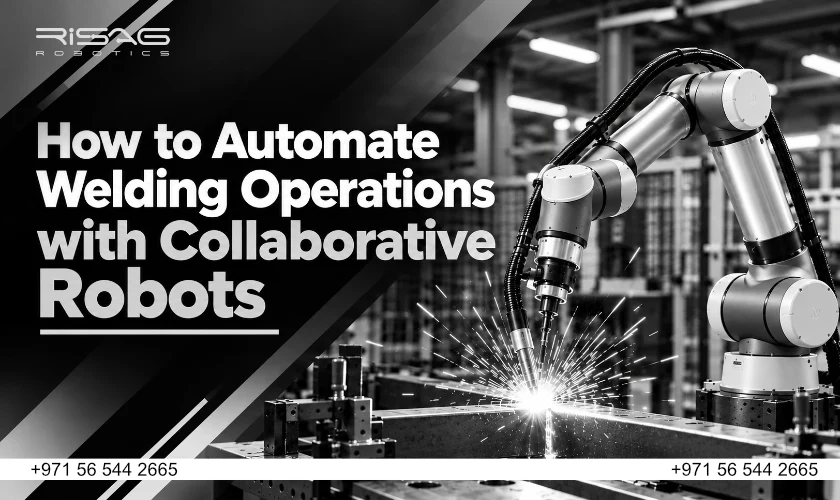
How to Automate Welding Operations with Collaborative Robots
- event_available 22-09-2026
Now, there is no need to explain how important a process welding is—especially for manufacturing and fabrication businesses. That being said, repeating the same welding job throughout the whole day can be time-consuming and tiring and often becomes difficult to maintain consistent quality.
So, what if a cobot is introduced to take up repetitive tasks?
Yes, welding cobots, or collaborative robots, can handle repetitive and consistent welding jobs, while skilled human workers can focus on work that requires quality checks, experience, and sharp decision-making.
Even so, the job isn’t done by just placing a cobot next to a welding machine. Because it is a complete system—the cobot, welding machine, workpiece, programming, fixture, and safety measure should come together.
Then follows the question—how? How is this done? Let’s find out.
What Is Cobot Welding?
Cobot welding is the process where collaborative robots are used to move the welding torch along the programmed path. The repeatable parts of the welding process are taken up by the cobot. This doesn’t mean that operators need to look into it at all. In fact, they have to be involved in setting up the process, positioning the parts, checking the weld quality, and handling the more complex works.
Collaborative robots are designed to be more flexible and easier to program, making them a smart option for businesses that want to kick-start welding automation.
Which Welding Jobs Can Be Automated?
The fact that cobots can be deployed in welding doesn’t automatically mean that they can take up every welding job. That’s why it is important to know for what all tasks cobot welding can be suitable for, and here are some of them listed:
- Repetitive welds
- Long and consistent welds
- Repeated filler welds
- Parts that are produced on a regular basis
- Medium-volume production
- Components that can be positioned accurately.
The last point is quite worth noting because it can be more difficult to automate welding works where the parts constantly change shape, positioning depends on the work, or when human judgement is inevitable.
What needs to be borne in mind is that not all welding operations need to be automated. Therefore, it is better to assess the process and determine whether the cobot is suited for the job.
How to Automate Welding With a Cobot?
1. Identify the Welding Task
Examine the current welding process and look into the important aspects, such as the types of parts produced, number of welds, weld length, production volume, and cycle time. Check whether the welding task requires high level of consistent repetition enough to automate them.
2. Check the Part and Welding Process
Now look into the welding requirements, which includes :
- Material and thickness
- Joint type
- Weld position
- Level of accuracy required
- Weld length
- Type of welding process
- Part tolerance
This information is crucial in determining the right type of cobot and welding equipment.
3. Choose the Right Cobot
The next step is choosing the right cobot; this involves considering the important factors such as payload, arm reach, repeatability, and most importantly workspace—you have to have room for the cobot, operator, and the workpiece. The cobot should be able to reach the weld path completely and safely handle the welding torch through out the process.
4. Build the Cobot Welding System
Now you have to set up the cobot welding system and a head start; it includes much more than just the robot arm. Depending on the application, it can include the following components:
- Cobot
- Welding power source
- Welding torch
- Wire feeder
- Torch mount
- Fixtures
- Worktable
- Control system and software
- Safety equipment
- Fume extractor or ventilation when required
Because the cobot is just one part of the entire setup.
5. Set Up the Workpiece
The workpiece needs to be held securely and positioned in the same way throughout the process. With a suitable fixture the cobots can reach the weld correctly, making production easier.
6. Program the Weld Path
The programming phase includes setting the weld points, movement path, entry and exit positions, and the required welding parameters. Most of the modern cobot welding systems are designed to make programming easier.
7. Test the Weld
This is a crucial step. You have to test the weld setup before putting them into regular production. Make sure to consider these parameters:
- Weld quality
- Torch position
- Travel speed
- Welding settings
- Spatter
- Possible distortions
- Cycle time
- Repeatability
It is important to test and adjust the process.
8. Introduce It Into Production
Once you confirm that the system is operational, integrate it into the regular production process. Also note that a cobot is a part of the project, and that entire welding system has to work around it.
What Are the Benefits of Cobot Welding?
Cobot welding offers several practical benefits when used for the right application.
Consistent weld paths: Once programmed, the cobots can repeat the assigned movements, ensuring consistency.
Less repetitive work: As the cobot handles the repetitive work, operators can focus on other important tasks.
Flexible automation: Operators can change the programs for different paths.
Better use of skilled workers: Skilled workers can spend more time on complex welding processes, setup, and inspection.
Cobot Welding vs. Traditional Robotic Welding
Both cobots and traditional robots can automate welding, but they do so in very different ways.
Cobots are more flexible, easier to redeploy, and are a good choice for applications where the production needs change frequently. Traditional robots, on the other hand, are suited to high-production needs where the major focus goes to speed and dedicated automation.
Also, using a cobot doesn’t mean that the work areas require fewer safety measures. With or without cobots, welding still produces heat, sparks, fumes, and radiation. Therefore, it is important that adequate safety measures be taken.
Is Cobot Welding Suited for Your UAE Business?
If your UAE business has welding as a daily production requirement with repetitive tasks taking a toll, introducing a cobot welding system will be helpful. It is very relevant for businesses involved in:
- Metal fabrication
- Steel fabrication
- Automotive components
- Machinery manufacturing
- General engineering
- Manufacturing workshops
How Much Does Cobot Welding Cost?
The total cost of a cobot welding set up can depend on several factors, such as the robot, welding equipment, fixtures, software, safety features, installation, integration, operator training, and maintenance.
The ROI depends on several other factors, such as utilization, production volume, cycle time, labor cost, quality/rework, and number of shifts.
Conclusion
So, are you ready to explore cobot welding automation for your UAE facility? For the right application, a cobot welding system can offer numerous practical benefits. By taking up the repetitive welding task and leaving the operators to focus on more complex works, cobot welding helps businesses to step into smart production.
If you are looking for the best cobot welding system in the UAE, Risag Robotics is your reliable partner. Our dedicated team can help you assess the welding process, understand the process requirements, and determine whether you need a cobot welding system. Contact us today to know more.